Modern commercial and industrial facilities demand unified control across HVAC, lighting, energy monitoring, and security infrastructure. Schneider Electric addresses these demands through its EcoStruxure Building platform. This Schneider building management systems guide explains the three-tier EcoStruxure architecture, core edge and field hardware, protocol integration strategies, engineering software workflows, and deployment constraints required for reliable building management system (BMS) implementations.
EcoStruxure Building Management Architecture Overview
Schneider Electric's Building Management System is structured around the EcoStruxure Building Operation (EBO) software framework. Built on an open three-tier architecture, the platform standardizes field-level communication and normalizes operational data for enterprise analysis.
- Apps, Analytics & Services (Top Tier): Software solutions such as EcoStruxure Building Advisor analyze field telemetry for predictive maintenance, system fault detection, and building energy optimization.
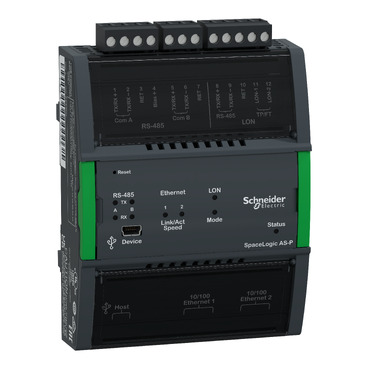
- Edge Control (Middle Tier): Processing hardware including Enterprise Servers and SpaceLogic Automation Servers (AS-P and AS-B) run localized control logic, alarm management, schedules, and cross-system data routing.
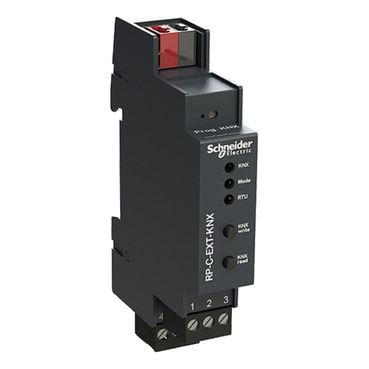
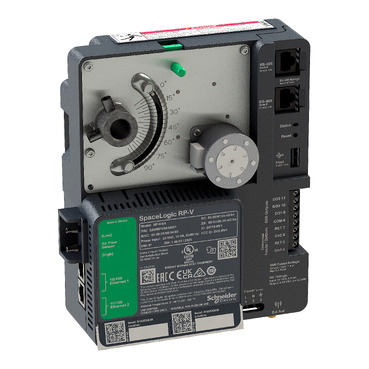
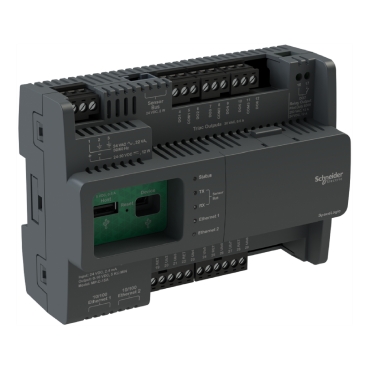
- Connected Products (Field Tier): Microprocessor-based hardware including SpaceLogic MP-C multi-purpose controllers, RP-C room controllers, smart sensors, and actuators directly interface with mechanical and electrical equipment.
Centralized oversight occurs within the software platform described in the EcoStruxure Building Operation documentation, allowing facility operators to supervise trends, alarms, and graphical representations across distributed facility footprints. For specialized engineering assistance on facility deployments, explore our BMS integration services.
Core Edge Controllers and Field Hardware Specifications
The hardware foundation of a Schneider Electric BMS uses modular servers and dedicated controllers designed for specific processing and input/output (I/O) requirements.
| Hardware Series | Primary Application | Key Operational Features |
|---|---|---|
| SpaceLogic AS-P & AS-B Servers | Edge-level control and central site communication | Dual Ethernet ports, hardware acceleration engines, multi-protocol routing, local database logging |
| SpaceLogic MP-C Series | HVAC central plant, air handling units, plant automation | Configurable universal I/O points, IP-at-the-field connectivity, support for expansion I/O modules |
| SpaceLogic RP-C Series | Room-level control (HVAC, lighting, shading) | Modular multi-sensor integration, Bluetooth commissioning options, expandable room control modules |
SpaceLogic Automation Servers act as the central communication gateways for field buses. Technical details provided in the SpaceLogic Automation Server specifications highlight their dual Ethernet port routing capabilities, onboard memory for trend storage, and flexible power supply options. At the physical equipment level, plant and air-handling automation utilizes SpaceLogic MP-C field controllers, detailed in the SpaceLogic MP Series Controllers technical catalog.
Protocol Integration and Network Topology Engineering
Modern BMS engineering requires direct interoperability across legacy field buses and high-speed Ethernet topologies. EcoStruxure edge controllers feature multi-protocol capabilities that remove the need for external third-party protocol converters.
- Native Protocol Support: Full support for BACnet/IP, BACnet MS/TP, Modbus TCP, Modbus RTU, LonWorks, and RESTful Web Services.
- IP-at-the-Field Level: Connecting dual-port SpaceLogic field controllers directly to Ethernet networks reduces latency and improves diagnostic visibility.
- Network Fault Tolerance: Dual Ethernet ports on field controllers support daisy-chain networks as well as Rapid Spanning Tree Protocol (RSTP) ring topologies to maintain communications if a network loop breaks.
When designing network infrastructures, refer to our detailed BACnet/IP network design guide to optimize subnet partitioning and packet performance. Additionally, integrating power meters alongside mechanical controllers requires applying Modbus TCP and RTU integration best practices to avoid address collisions and timing conflicts.
System Configuration, Engineering, and Commissioning Workflow
System configuration in an EcoStruxure deployment relies on software tools designed for database management, logic creation, and field commissioning.
Engineers program control routines inside EcoStruxure Building Operation WorkStation using either Function Block Programming (a visual environment ideal for standard HVAC sequences) or Script Programming (a text-based language suited for mathematical calculations and custom logical routines). WorkStation also acts as the database management center for graphics, user access controls, and trend schedules.
Field setup and I/O validation are accelerated using the eCommission SmartX Controllers mobile application. This mobile tool enables technicians to perform network configuration, point checkout, and actuator balancing prior to server connection, reducing physical setup time on job sites.
Technical Limitations, Hardware Constraints, and Selection Criteria
Engineers and system specifiers must account for operational boundaries and hardware limitations during initial system design.
- Database and Capacity Scale Limits: Node count and I/O point limits per Automation Server (AS-P/AS-B) and Enterprise Server vary according to the active EcoStruxure Building Operation software version (such as v3.x, v4.x, or v5.x). Specifiers should confirm object limits against software release notes.
- Controller I/O Constraints: Universal inputs, digital outputs, and analog outputs vary across specific controller sub-models (e.g., MP-C-15A vs. MP-C-18A). Verify pinout definitions and signal compatibility prior to hardware procurement.
- Cybersecurity Hardening: Achieving cybersecurity standards like IEC 62443-4-2 depends on deploying qualified firmware releases, enabling encrypted communication protocols (HTTPS, BACnet SC), implementing role-based authorization, and isolating field automation networks behind network firewalls.