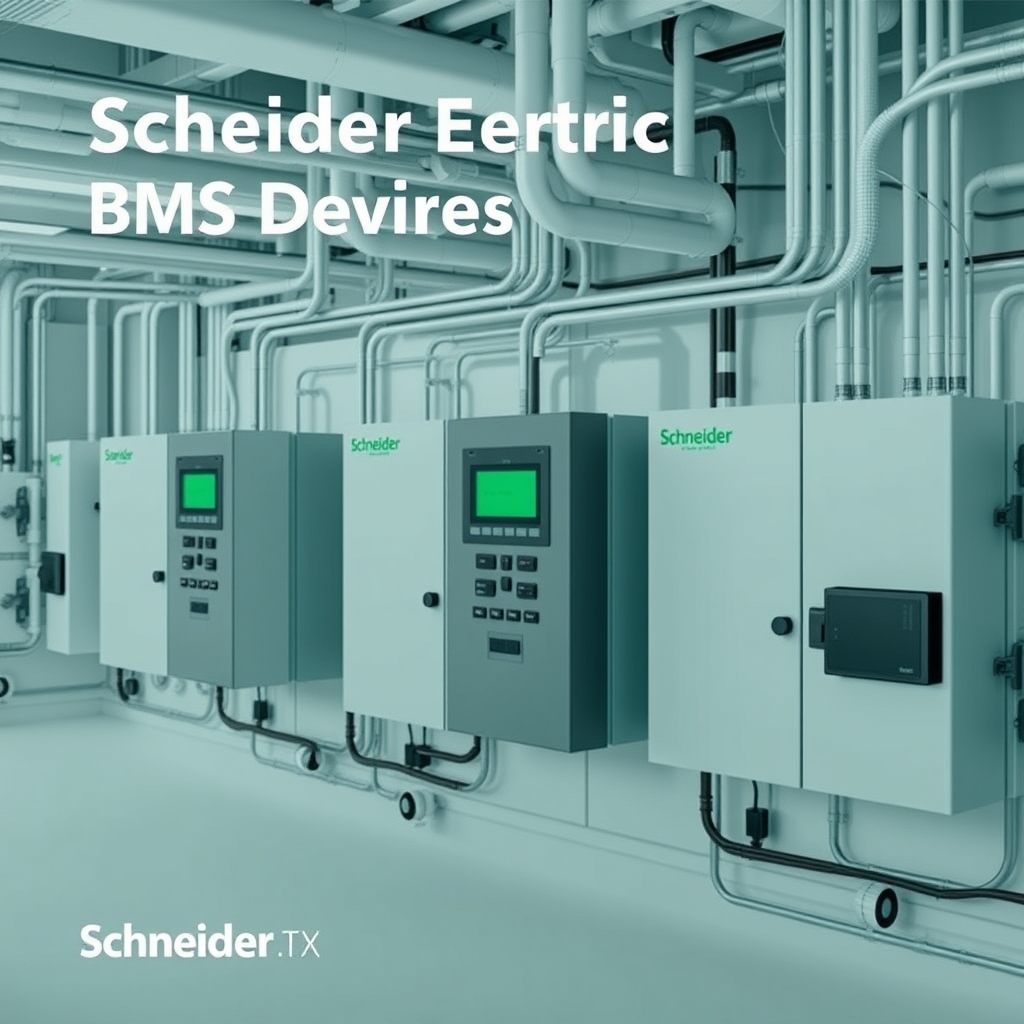
Modern building management systems require modular, reliable, and secure hardware architecture to handle complex HVAC, power monitoring, and environmental controls. The portfolio of Schneider Electric BMS devices built on the SpaceLogic brand forms the hardware backbone of the EcoStruxure Building Operation (EBO) platform. From high-capacity server engines down to precision field instrumentation, understanding how these components interoperate is critical for MEP consultants, BMS system integrators, and facility engineers designing robust automation networks.
Integrating plant-level automation with enterprise software requires a clear multi-tiered strategy. For full turnkey implementation and system architecture consultation, explore our dedicated EnergyX BMS integration services.
Architecture Overview: SpaceLogic Device Ecosystem in EcoStruxure Building Operation
The Schneider Electric SpaceLogic hardware ecosystem follows a structured three-tier architecture: Management Level (Enterprise Server and Workstation), Control Level (Automation Servers and Field Controllers), and Field Level (Sensors, Actuators, and Meters). Transitioning away from legacy proprietary fieldbus protocols like TAC I/NET, Andover Continuum, or Satchwell, modern SpaceLogic hardware relies heavily on native Ethernet/IP connectivity and universal open protocols.
- IP-First Networking: IP-native controllers bring Ethernet direct to the unit level, accelerating data polling and enabling direct software integration.
- Protocol Conversion & Routing: Automation servers function as hardware gateways, seamlessly mapping BACnet MS/TP, Modbus RTU, and Modbus TCP into unified BACnet IP networks.
- Distributed Processing: Control logic executes locally on hardware controllers, ensuring continuous stand-alone operation even if upstream server connectivity is temporarily interrupted.
Engineers structuring building automation systems can read more about network protocol selection in our detailed analysis of BACnet IP vs MS/TP architecture.
SpaceLogic AS-P Automation Server: Core Processing & Network Engine
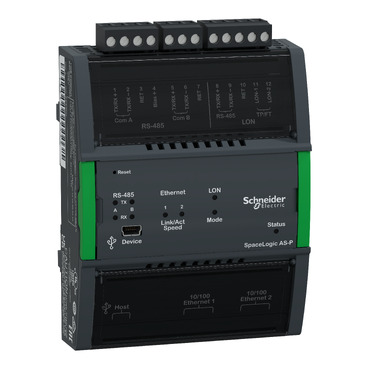
At the center of central plant control and network orchestration is the SpaceLogic AS-P (Automation Server Processor). The AS-P is a high-performance embedded server device engineered to run local database management, host historical trend logs, execute automated schedules, and run complex Script or Function Block control programs.
Key hardware parameters specified in the official SpaceLogic Automation Server AS-P Specification Sheet include dual 10/100 Ethernet ports, two RS-485 serial ports for BACnet MS/TP or Modbus communications, and dedicated USB host/device ports. The dual Ethernet architecture supports network isolation, allowing one port to connect to the client enterprise network while the second port manages a dedicated field-level controller loop.
| Hardware Feature | SpaceLogic AS-P Specification | Operational Benefit |
|---|---|---|
| Processor & Memory | High-speed dual-core ARM, extended flash memory | Fast execution of control loops and dense local trend storage |
| Dual Ethernet Ports | 2x RJ45 (10/100 Base-T) | Network segregation between corporate IT and field controller networks |
| Serial Ports | 2x RS-485 (Isolated) | Direct connectivity for BACnet MS/TP trunks and Modbus RTU devices |
| Software Engine | EcoStruxure Building Operation Embedded Server | Local database execution, scheduling, alarms, and web servicing |
Engineering teams must maintain firmware parity across the installation. System upgrades or field device commissioning require verifying software versions; running mismatched firmware versions between the SpaceLogic AS-P and downstream field units can trigger feature deprecation or offline device communication faults inside EBO. Learn more about software deployment in our EcoStruxure Building Operation engineering guide.
SpaceLogic Centralized I/O Modules & Terminal Power Infrastructure
When the AS-P is installed in central plant mechanical rooms or main control panels, it interfaces directly with SpaceLogic centralized I/O modules via a shared backplane bus base. These DIN-rail mounted modules process hardwired points from sensors, switches, control valves, and pump starters.
- Digital Input (DI) Modules: Monitor dry contact statuses such as pump run/fault relays, filter differential pressure switches, and airflow status switches.
- Digital Output (DO / Relay) Modules: Provide Form-C relay contacts to command start/stop sequences for constant-speed fans, pumps, and stage heaters.
- Analog Input (AI) Modules: Read precision resistance signals (PT1000, NTC thermistors) and 0–10 VDC / 4–20 mA process inputs from pressure and temperature transmitters.
- Universal Input/Output (UIO) Modules: Software-configurable channels capable of operating as AI, AO, DI, or DO, maximizing panel space efficiency.
Hot-swappable bus bases permit module replacement without disrupting power or communication to adjacent I/O modules on the same DIN rail. Hardware engineers must calculate total backplane power bus load; if the total current consumption of connected I/O modules exceeds the AS-P internal power supply rating, an auxiliary SpaceLogic Power Supply Module (PS-24V) must be installed to prevent backplane voltage drops.
SpaceLogic IP Controllers: MP-C Plant Control & MP-V Terminal Units
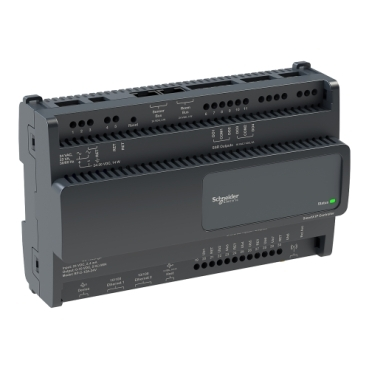
To reduce system latency and remove single-point-of-failure risks associated with centralized I/O systems, Schneider Electric provides SpaceLogic IP-based field controllers. As detailed in the SpaceLogic MP-C product range documentation, these devices bring IP capabilities directly to central plants, air handling units (AHUs), and variable air volume (VAV) boxes.
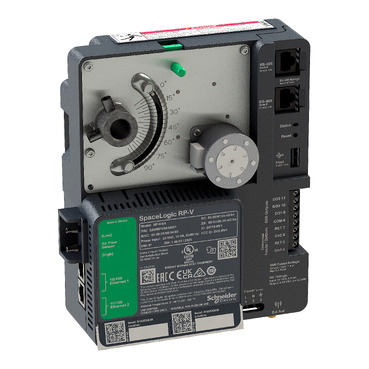
The SpaceLogic MP-C (Multi-Purpose Controller) features flexible input/output channel mixes, programmable onboard logic, and optional display modules for local monitoring. The SpaceLogic MP-V (VAV Controller) incorporates an integrated digital differential pressure sensor and precision damper actuator drive motor, specifically optimized for terminal VAV air balance applications.
Deploying IP field controllers requires strict network topology planning. SpaceLogic IP controllers feature dual RJ45 ports with integrated Ethernet switches, enabling ring topologies using Rapid Spanning Tree Protocol (RSTP). To maintain loop convergence performance and avoid broadcast storms, engineers must adhere to network physical limits: a single RSTP ring should not exceed 39 controllers per loop, and daisy-chain topology lengths must be kept within recommended network limits.
SpaceLogic Connected Room Solution: RP-C Room Controllers & Smart Sensors
For modern commercial offices, hotels, and healthcare facilities, room-level environmental management demands personalized control of HVAC, lighting, and solar shading. The SpaceLogic Connected Room Solution uses the RP-C (Room Controller) as its local computing node.
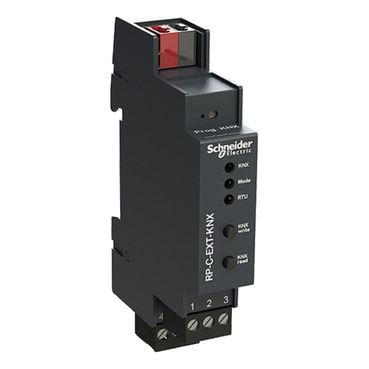
According to the official SpaceLogic Connected Room Solution documentation, the RP-C is a fully programmable BACnet IP room controller that supports modular expansion units for DALI lighting control and high-voltage blind control. Key features include:
- Wireless Network Expansion: Optional onboard plug-in modules add Bluetooth Low Energy (BLE) and Zigbee 3.0 wireless capabilities for wireless sensor pods and mobile occupant room control apps.
- Living Space Sensors & Touchscreens: Smart wall sensors measure dry-bulb temperature, relative humidity, carbon dioxide (CO2), and total volatile organic compounds (TVOC) over a simple digital bus link.
- Modular Power Sizing: When engineering dense room networks, local power budgets for sensor buses and expansion modules must be strictly validated to prevent over-subscription of internal controller supply buses.
Schneider Electric Field Devices: Valves, Actuators, and Transmitters
A BMS is only as accurate and reliable as its physical interface with mechanical systems. Schneider Electric manufactures a broad family of peripheral field devices engineered for native pairing with SpaceLogic controllers.
Fluid flow management relies on SpaceLogic globe, ball, and butterfly control valve assemblies paired with direct-coupled electronic actuators. For proportional control, actuators accept 0-10 VDC or 4-20 mA control signals and return position feedback signals to the controller. Selecting the correct control valve requires evaluating flow coefficients (Cv/Kv), close-off pressure ratings, and equal percentage vs. linear flow characteristics. For details on mechanical valve selection, review our HVAC valve and actuator selection guide.
Field sensing devices include immersion water temperature probes, outdoor air enthalpy sensors, duct static pressure transmitters, and inline electromagnetic flow meters. Ground loop prevention is essential during field wiring: analog input signal cables (4-20 mA or 0-10 V) must use shielded twisted-pair conductors, with shields grounded strictly at one single termination point inside the BMS panel.
Engineering Selection Matrix & Hardware Limitations
Selecting the optimal combination of Schneider Electric BMS devices requires matching hardware capabilities to application scale and spatial layouts. The matrix below provides decision guidelines for standard building automation applications.
| Application Profile | Primary Processing Hardware | Field/Terminal Devices | Key Hardware Constraints |
|---|---|---|---|
| Central Chiller Plant / Boiler Room | SpaceLogic AS-P with Centralized I/O Modules & MP-C IP Controllers | Pressure transmitters, flow meters, heavy-duty valve actuators | Verify module bus load power limits; isolate high-voltage relay wiring |
| Large Air Handling Units (AHU) | SpaceLogic MP-C (IP-native) | Duct temp/humidity sensors, freeze stats, modulating damper actuators | Ensure RSTP loop limits (<=39 nodes); shield analog signal lines |
| VAV Terminal Air Units | SpaceLogic MP-V (IP-native) | Smart room sensors, pickup tubes, integrated damper actuator | Calibrate differential pressure zero-point during air balancing |
| Commercial Office / Hotel Rooms | SpaceLogic RP-C Room Controller | Living Space Sensors, DALI lighting modules, wireless sensor pods | Calculate total sensor bus power draw; respect wireless range limits |
Successful installation requires disciplined engineering practices during panel build and field commissioning. Always structure IP address schemes logically using static DHCP reservations or managed static IP pools, verify power supply loading factors prior to energization, and ensure field instrument shield drain wires are cleanly isolated from earth contact inside field conduit boxes.