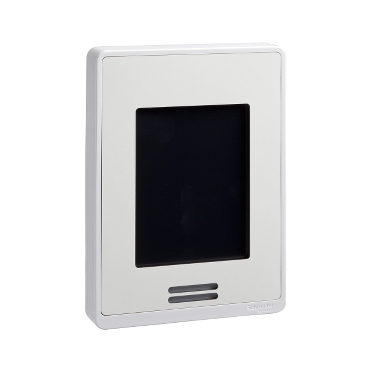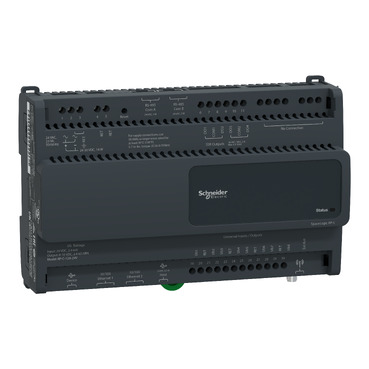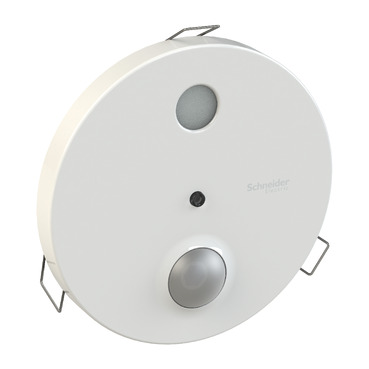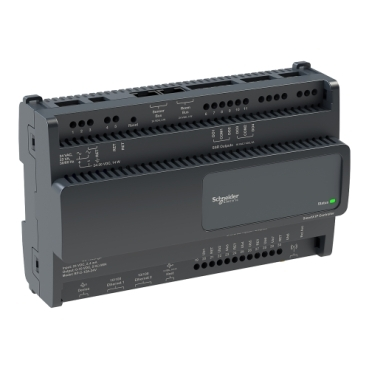
The Schneider Electric SpaceLogic RP-C (Room Controller) represents a modern architecture for decentralized, IP-based building automation. Positioned within the EcoStruxure Building Operation (EBO) ecosystem, the RP-C is a high-performance field controller designed for connected room solutions. By combining native BACnet/IP communications, flexible I/O channels, wireless commissioning tools, and modular expansion capabilities, the RP-C allows controls engineers to implement unified HVAC, lighting, and shade management strategies within a single space.
Understanding the hardware architecture, physical layer options, and protocol capabilities of the SpaceLogic RP-C controller is crucial for designing reliable, scalable Building Management Systems (BMS). This guide reviews the core technical specifications, network topologies, modular expansion options, and field commissioning workflows required for professional deployment.
SpaceLogic RP-C Architecture and Dual Ethernet Networking
At the core of the SpaceLogic RP-C controller design is native BACnet/IP field network connectivity. Moving away from traditional MS/TP serial buses, the RP-C leverages high-speed IP infrastructure directly down to the terminal unit level. The hardware features dual RJ-45 Ethernet ports backed by an internal two-port Ethernet switch. This switch supports multiple physical networking arrangements:
- Daisy-Chain Topology: Controllers are wired in series from one device port to the next, significantly reducing cabling runs across repetitive floor plans compared to home-run star topologies.
- RSTP Ring Topology: By enabling Rapid Spanning Tree Protocol (IEEE 802.1w), the RP-C controllers can be arranged in a closed loop. If a single cable breaks or a controller loses power, the network automatically re-routes communications in milliseconds, ensuring zero operational downtime for the remaining controllers on the loop.
- Star Topology: Each controller connects directly to an IT network switch port where maximum isolation or segmented network policies are required.
For detailed technical specs regarding network port behavior, dual-port switch configurations, and protocol stacks, refer to the official SpaceLogic RP-C Controller Technical Overview.
In addition to the main Ethernet ports, the RP-C includes a dedicated Sensor Bus port. This RS-485 interface is reserved for connecting SpaceLogic Smart Sensors directly to the controller. By isolating room temperature, humidity, CO2, and motion sensors onto the dedicated Sensor Bus, precious universal I/O channels remain free for primary mechanical equipment control.
RP-C Model Variants and Technical I/O Specifications
The SpaceLogic RP-C platform is available in several hardware variants tailored to specific room equipment footprints, such as Fan Coil Units (FCU), Variable Air Volume (VAV) boxes, chilled beams, and radiant panels. Key models in the family include the RP-C-12A, RP-C-12B, and RP-C-16A configurations, which vary in onboard channel density and power supply mechanisms.
Before selecting a specific controller variant for engineering design, engineers must verify the precise terminal allocation and voltage requirements from the SpaceLogic RP Controller Specification Sheet. The general I/O capability across the platform relies on software-configurable Universal Inputs/Outputs (UIO).
Universal Input/Output (UIO) Capabilities
Each Universal I/O channel on an RP-C controller can be software-configured in EcoStruxure Building Operation to support various physical signal types:
- Temperature/Resistance: Compatible with various thermistors (e.g., 10k ohm Type II/III) and resistive elements.
- Voltage Input: 0 to 10 VDC analog measurements for pressure transmitters or air quality monitors.
- Current Input: 0/4 to 20 mA analog inputs with appropriate precision shunt resistors.
- Digital/Counter Inputs: Dry contact sensing for occupancy switches, door contacts, or pulse counting.
- Voltage Output: 0 to 10 VDC active outputs for modulating valve actuators or variable-speed fan drives.
| Hardware Variant | Power Supply Input | Universal I/O Count | Relay Outputs | Primary HVAC Application |
|---|---|---|---|---|
| RP-C-12A | 24 VAC / 24 VDC | 8 UIO | 4 High-Current Relays | Hydronic Fan Coil Units, Chilled Beams |
| RP-C-12B | 24 VAC / 24 VDC | 8 UIO | 4 Solid State Relays (SSR) | VAV Terminal Units with Tri-state Actuators |
| RP-C-16A | 230 VAC / Line Power | 8 UIO | 8 Relays (Mixed Rating) | Direct Line-Powered FCU & Room Equipment |
For complex installations requiring integrated power management alongside automation, engineering teams often pair RP-C room nodes with centralized Building Management System engineering services to coordinate overall energy delivery across the facility.
Connected Room Solutions and Plug-and-Play Expansion Modules
Modern commercial buildings demand integrated control over indoor environmental quality, including lighting levels and solar shading. The SpaceLogic RP-C supports Schneider Electric's Connected Room Solutions architecture by serving as the central room hub. Via its dedicated Room Bus interface, the RP-C accepts plug-and-play expansion modules without requiring additional network switch ports or complex IP addressing.
Available Room Expansion Modules
- DALI Lighting Modules: Connects DALI-2 compliant lighting ballasts and LED drivers directly to the room controller, enabling addressable dimming, daylight harvesting, and emergency light monitoring.
- 0-10V Dimming Modules: Controls analog dimmable LED fixtures across multiple lighting zones.
- SMI / Relay Blind Modules: Interfaces with Standard Motor Interface (SMI) motorized window blinds or standard AC/DC motorized shades for dynamic glare control and solar heat gain mitigation.
- Multi-Sensor Expansion: Integrates ceiling-mounted motion, lux, and infrared sensors directly into the room management system.
The physical Room Bus utilizes an RS-485 signaling protocol, providing power and communications to attached modules over a single cable run up to 100 meters, depending on module current draw. This modularity allows contractors to scale room capabilities from basic HVAC control to complete hotel or high-end office automation without replacing the base RP-C field hardware.
Commissioning Workflows: eCommission Mobile App and EBO Integration
Deploying room controllers across large-scale commercial real estate can present significant labor challenges. The RP-C platform streamlines field installation using a mobile-first commissioning workflow driven by Bluetooth Low Energy (BLE) technology.
1. Wireless Field Commissioning via eCommission App
Each RP-C controller, or its connected SpaceLogic Smart Sensor, includes onboard BLE hardware. Commissioning technicians use the Schneider Electric eCommission SmartX Controllers mobile application on a smartphone or tablet to perform field tasks without physical network cables:
- Zero-Power Staging: Unpack, address, and pre-configure controller network settings prior to high-voltage mains power connection.
- Point-to-Point I/O Checkout: Override physical outputs, calibrate temperature offsets, and verify valve/damper motion locally while standing next to the mechanical equipment.
- Automated Test Reporting: Generate verified commissioning reports directly from the mobile tool for quality assurance documentation.
2. EcoStruxure Building Operation (EBO) Binding
Once field wiring and I/O validation are finished using the mobile tool, the RP-C controllers are bound to the central EBO infrastructure:
- BACnet Discovery: The EBO Automation Server (AS-P or AS-B) scans the Ethernet subnet or RSTP ring to discover newly connected RP-C BACnet device objects.
- Database Synchronization: Control applications written in Function Block or Script language are loaded into the RP-C memory.
- Trend Log & Alarm Provisioning: Historical trend objects and BACnet alarm notification classes are bound back to the EBO Enterprise Server for continuous Monitoring and Target Analysis.
To explore the broader hardware matrix and software tools supporting this architecture, review the SpaceLogic RP-C BACnet/IP Room Controller Product Range.
Engineering Decision Matrix and Implementation Limitations
While the SpaceLogic RP-C is a highly versatile room controller, system designers must account for key technical constraints during the submittal and engineering phases.
Equipment Application Decision Matrix
| Mechanical Equipment Type | Recommended RP-C Model | Key Expansion / Accessory | Primary Engineering Considerations |
|---|---|---|---|
| 4-Pipe Fan Coil Unit (Line Voltage Fan) | RP-C-16A | SpaceLogic Smart Sensor (Touchscreen) | Verify relay channel current limits for high-speed fan motor starters. |
| 2-Pipe FCU with 0-10V ECM Fan | RP-C-12A | 0-10V Lighting Expansion Module | Utilize UIO for modulating water valves and ECM fan speed control signal. |
| VAV Terminal Unit with Electric Reheat | RP-C-12B | Integrated Airflow Pressure Transducer | SSR outputs are optimized for tri-state floating actuators and pulsed heater relays. |
| Chilled Beam with DALI Daylight Control | RP-C-12A | DALI-2 Light Expansion Module | Ensure Room Bus power budget supports both DALI module and ceiling multi-sensors. |
Engineering Constraints and Technical Warnings
- Power Budget Limits: The total current draw of attached Sensor Bus devices and Room Bus expansion modules must not exceed the maximum auxiliary output power ratings specified for the base RP-C model. External 24 VDC power supplies must be specified when exceeding expansion limits.
- Terminal Relay Switching Limits: Onboard digital relay outputs must be checked against motor inductive inrush ratings. High-horsepower fan motors require external interposing relays or magnetic contactors.
- Cybersecurity Provisioning: Because RP-C controllers connect directly to IP networks, BACnet network security policies must be implemented. Port security, 802.1X authentication, and strict BLE passkey management must be enforced in the eCommission tool during field provisioning.
- Ambient Temperature Thresholds: RP-C controllers installed inside ceiling plenums or fan coil enclosures must operate within specified ambient temperature and non-condensing humidity envelopes to avoid hardware degradation.
For custom engineering advice, network topology reviews, or system pricing on Schneider Electric BMS hardware, request a technical quotation from EnergyX Egypt's engineering team.