Modern commercial buildings, industrial facilities, and large-scale campuses rely on intelligent Building Management Systems (BMS) to control environmental systems, optimize energy usage, and maintain high operational reliability. Schneider Electric's EcoStruxure Building Operation (EBO) provides a scalable software and hardware platform designed to unify disparate building subsystems into a single managed environment. Understanding the EcoStruxure Building Operation architecture is essential for system integrators, mechanical consultants, and facility automation engineers designing systems capable of handling high point counts, fast control loops, and enterprise-grade data management.
The platform scales from standalone single-building installations to multi-site global enterprises. By establishing a clear separation of operational layers—from high-level cloud analytics down to field-level sensor actuation—EBO ensures deterministic edge control while providing deep visibility across facility operations. For complete lifecycle support and engineering implementation, explore our building management systems integration services.
EcoStruxure Three-Tier Architectural Framework
Schneider Electric builds its IoT-enabled automation solutions around a standardized three-tier framework. EcoStruxure Building Operation maps directly into this framework, maintaining a clean functional distinction between field hardware, real-time edge processing, and high-level enterprise software applications.
- Apps, Analytics & Services (Top Tier): This tier focuses on intelligence, optimization, and predictive maintenance. Applications such as Building Advisor, Microgrid Advisor, and Resource Advisor aggregate telemetry across multiple properties. They leverage historical trends to identify energy wastage, detect equipment faults, and automate energy scheduling. Access to these higher-level tools is enabled through standard cloud interfaces and secure RESTful Web Services. Detailed product specifications and ecosystem details can be reviewed in the EcoStruxure Building Operation Global Product Range guide.
- Edge Control (Middle Tier): The core operational engine of the system resides in the Edge Control tier. Here, system management servers and edge controllers handle real-time logic, process alarms, maintain schedules, manage historical logs, and route data across communication networks. Edge controllers execute deterministic control sequences independently of higher-tier servers, ensuring facility operations continue uninterrupted even during external network outages.
- Connected Products (Field Tier): The physical layer contains sensors, valve actuators, power meters, smart thermostats, variable speed drives, and dedicated field controllers. These devices capture physical environmental variables (such as temperature, humidity, pressure, and electrical current) and execute control outputs issued by field controllers.
Server Topology: Enterprise Central, Enterprise Server, and Automation Servers
Scalability in EBO is achieved through a multi-tiered server hierarchy. Depending on physical footprint, node count, and administrative requirements, an architecture can combine up to three server tiers to aggregate data seamlessly.
Enterprise Central (EC)
Enterprise Central serves as the supreme head-end management server in large-scale multi-site installations, multi-building campuses, or regional corporate real estate portfolios. EC sits above multiple Enterprise Servers, consolidating alarming, trending, user access control, and system configuration into a single top-level user workstation interface. System administrators can apply global graphics, configure centralized single sign-on (SSO) via Active Directory, and roll out security patches across hundreds of remote facilities simultaneously without logging into individual site servers.
Enterprise Server (ES)
The Enterprise Server functions as the central management node for a single facility or a localized cluster of buildings. Operating on Windows-based server or workstation hardware, the ES manages central trend logs, master schedules, historical databases (such as PostgreSQL), and site-wide alarm routing. It serves as the primary communication bridge for operator interfaces, including Workstation (fat client) and WebStation (browser-based client). While the ES coordinates global schedules and collects long-term data, critical real-time direct digital control (DDC) loops remain decentralized at the edge controller tier. Engineers configuring site software can follow our detailed Enterprise Server setup guide for optimal database installation and network configuration.
Automation Servers (AS-P and AS-B)
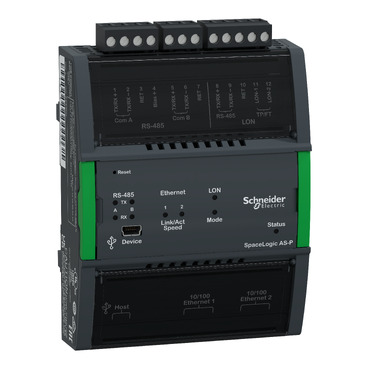
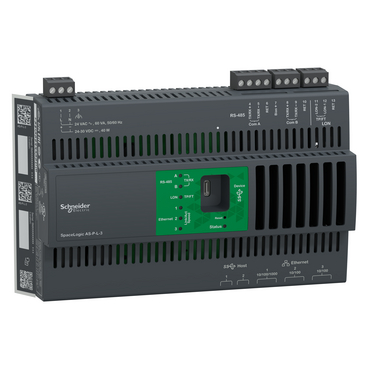
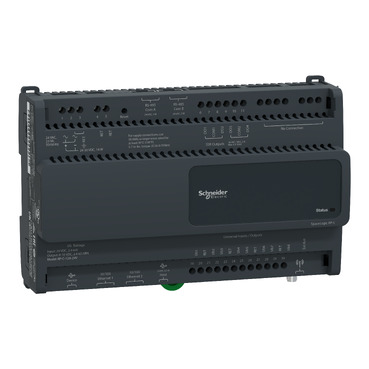
Automation Servers are embedded, real-time, DIN-rail mounted hardware devices that act as the physical backbone of the Edge Control layer. They run a secure Linux-based operating system and serve dual functions: executing real-time control scripts (Function Block or Script programming) and acting as multi-protocol communication gateways. Automation Servers communicate upwards to the Enterprise Server via Ethernet and downward to field devices over IP or serial field buses.
- Automation Server-P (AS-P): A high-performance edge server equipped with dual Ethernet ports, dedicated RS-485 ports, a LonWorks port, and support for direct-attached snap-in I/O expansion modules on backplane bases. Designed for high-density plant rooms, complex mechanical systems, and heavy network routing tasks.
- Automation Server-B (AS-B): A compact edge server with built-in fixed I/O channels. The AS-B is tailored for smaller plant rooms, secondary mechanical spaces, or terminal unit consolidation where external module expansion is unnecessary.
For a detailed hardware spec analysis, review our AS-P vs AS-B comparison guide. Formal system documentation and software operational guidelines can also be queried via the EcoStruxure Building Operation WebHelp Portal.
Field Controllers and Protocol Integration Layer
Field controllers bridge the physical building components to the server tier. EcoStruxure Building Operation incorporates SpaceLogic IP and RS-485 field controllers to manage terminal units, air handlers, fan coil units, and chillers.
SpaceLogic MP-C and RP-C Controllers
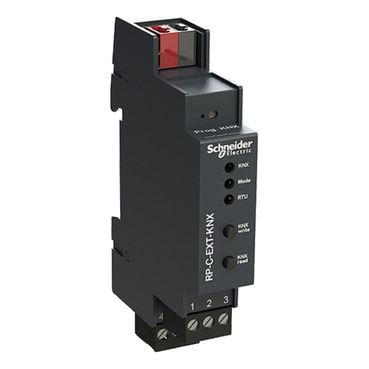
The SpaceLogic controller family introduces native IP connectivity directly down to terminal control loops. Multi-Purpose Controllers (MP-C) and Room-Purpose Controllers (RP-C) offer dedicated physical I/O points, customizable control logic, and flexible expansion modules. Operating natively on Ethernet networks, SpaceLogic IP controllers support ring topologies utilizing Rapid Spanning Tree Protocol (RSTP). This arrangement ensures that a single severed network cable does not break communication to field devices.
For serial deployment scenarios, SpaceLogic controllers also operate over traditional RS-485 field buses, giving control engineers flexibility across retrofit and new construction projects. Step-by-step controller setup procedures are covered in our SpaceLogic MP-C/RP-C configuration tutorial.
Multi-Protocol System Integration
Modern facilities rarely rely on a single equipment manufacturer. EBO handles multi-vendor environments by offering native multi-protocol conversion directly inside Automation Servers without requiring third-party protocol translation gateways. Supported protocols include:
- BACnet/IP & BACnet MS/TP: Fully compliant BACnet Building Controller (B-BC) profile support, handling B-BIBBs, object routing, dynamic discovery, and master/slave communication. For network protocol design best practices, refer to our BACnet/IP vs MS/TP design guide.
- Modbus TCP & Modbus RTU: Direct mapping of register tables for electrical meters, variable frequency drives (VFDs), chillers, and generator sets.
- LonWorks (FT-10): Native LonWorks ports on AS-P servers enable seamless integration with legacy LonWorks networks and neuron-based equipment.
- Web Services (EWS / REST): EcoStruxure Web Services allow standardized data exchange between EBO and third-party enterprise platforms, such as property management tools, computer-aided facility management (CAFM) systems, and custom weather feed APIs.
Architectural Decision Support and Sizing Matrix
Selecting the optimal topology requires balancing point capacities, network bandwidth, physical location, and redundancy requirements. The table below provides design guidance across standard building deployment profiles.
| Deployment Profile | Recommended Top-Tier Server | Edge Server Architecture | Field Network Backbone | Typical Point Capacity |
|---|---|---|---|---|
| Single Commercial Building | Enterprise Server (Standalone) | 1-4 AS-P / AS-B Servers | RS-485 (BACnet MS/TP) or standard Ethernet | 500 to 5,000 Points |
| Multi-Building Campus | Enterprise Server | 10-50 AS-P Servers | Gigabit IP Network with RSTP Ring Field Loops | 5,000 to 50,000 Points |
| Global / Multi-Site Portfolio | Enterprise Central | Multiple Enterprise Servers | Hybrid IP / VPN with edge-cached telemetry | 50,000+ Points |
Hardware Limitations and Version-Specific Considerations
Engineering a robust EcoStruxure solution requires strict adherence to system boundaries and software version requirements. System designers must account for processing, memory, and database scaling constraints during the submittal and design phase.
AS-P and AS-B Physical Boundaries
While AS-P edge servers provide robust processing capabilities, hardware limits must be observed. Backplane expansion buses support up to a specified maximum number of I/O expansion modules (typically up to 32 modules depending on terminal base power consumption and backplane current consumption). Exceeding power supply limits requires secondary power expansion modules. Additionally, dual Ethernet ports on AS-P servers must be properly configured for either dual IP network isolation or daisy-chain switching to prevent network loop broadcast storms when RSTP is disabled.
Software Version Dependencies and Licensing
Maximum point capacities, server hierarchy limits, and licensed feature availability vary significantly across EcoStruxure Building Operation software versions (e.g., EBO v3.x vs. v4.x vs. v5.x). For example, recent software generations expanded native IP controller hosting capabilities per Enterprise Server, improved security protocols (TLS 1.3 compliance), and optimized historical trend engine performance. System architects must verify exact release notes and deployment guidelines on the EcoStruxure Specification Overview before committing server sizing calculations.
Database Sizing and Historical Retention
Long-term trend logging and audit trail requirements consume significant disk space. While Automation Servers store short-term trends in onboard RAM and flash memory, continuous sampling (e.g., 1-minute intervals across thousands of points) will quickly fill edge storage. The Enterprise Server must be provisioned with sufficient storage and automatic database archiving parameters to move edge logs seamlessly into persistent storage without degrading server processing performance.