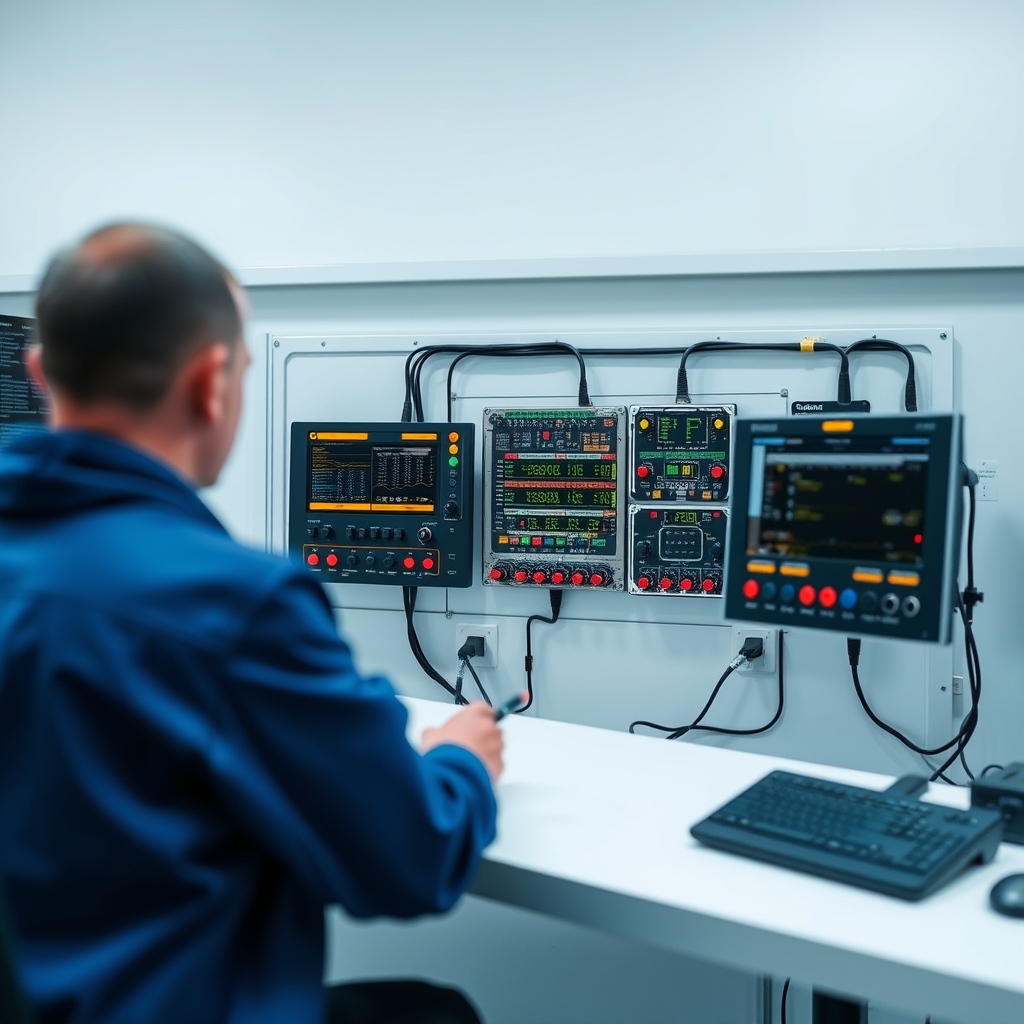
Designing a modern Building Management System (BMS) requires balancing network resilience, signal processing capacity, physical footprint, and field installation speed. Within Schneider Electric's EcoStruxure Building Operation (EBO) architecture, the SpaceLogic controller hardware suite provides scalable options ranging from central automation servers to IP-based field controllers and modular room automation devices. Selecting the optimal device profile for each node requires a systematic evaluation of physical I/O requirements, communications protocols, network topologies, and expansion capabilities.
To assist system integrators and mechanical/electrical consultants in specifying hardware, this technical guide outlines the core engineering questions every BMS designer must ask during the design phase. Integrating robust engineering practices and reviewing specialized Building Management System engineering services can further streamline engineering workflows across complex facilities.
Network Topology & Protocol: IP Ring vs. MS/TP
One of the initial design decisions involves determining how control communication will traverse the building network infrastructure. BMS designers must decide between IP-to-the-edge architectures (using BACnet IP over Ethernet) and traditional fieldbus networks (such as BACnet MS/TP or Modbus RTU over RS-485).
- Bandwidth and Data Speed: Native Ethernet IP devices transmit data at speeds up to 100 Mbps or 1 Gbps, facilitating rapid trend logging, fast alarm delivery, and seamless firmware updates across hundreds of field devices.
- Resiliency via RSTP: SpaceLogic IP controllers feature dual Ethernet ports allowing Daisy-Chain or Rapid Spanning Tree Protocol (RSTP) ring topologies. In an RSTP configuration, a break in the Ethernet cable does not disrupt communication, as traffic instantly reroutes around the broken segment. Note that the maximum node count per IP ring topology varies depending on managed network switch specifications, switch recovery performance, and central server processing capacity; designers must verify exact architecture constraints in Schneider Electric EcoStruxure deployment guides.
- Cost and Distance Trade-offs: RS-485 serial networks (BACnet MS/TP) require lower upfront cabling costs and support long cable runs (up to 1200 meters without repeaters), making them viable for distributed, low-density field points. However, IP controllers eliminate the need for serial gateways, simplify troubleshooting, and ensure compliance with modern IT security protocols.
Hardware compatibility can be verified directly through official testing profiles, such as the BACnet International BTL Listing, which certifies BACnet Building Controller (B-BC) compliance for SpaceLogic hardware.
Server Level vs. Field Level Role Assignment
In the EcoStruxure platform, controllers are separated into central server/gateway roles and field execution devices. Designers must clearly assign responsibilities to prevent network latency and single points of failure.
| Device Family | Primary Functional Role | Supported Protocols | Deployment Location |
|---|---|---|---|
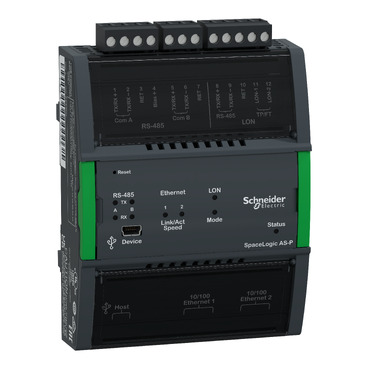
| Automation Server (AS-P / AS-B) | Central processing, scheduling, trend storage, gateway protocol translation | BACnet IP, BACnet MS/TP, Modbus RTU/TCP, LonWorks (via module) | Main control panels, equipment rooms |
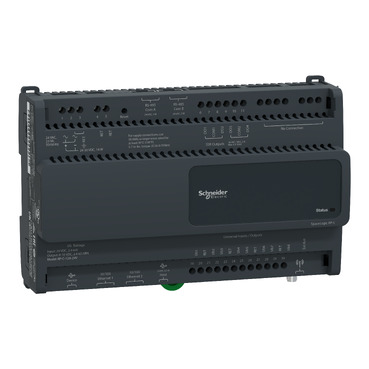
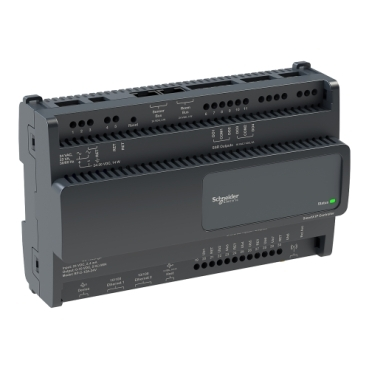
| SpaceLogic MP-C | Multi-purpose plant & air handling unit execution | BACnet IP (B-BC), Modbus RTU | AHU panels, boiler/chiller mechanical rooms |
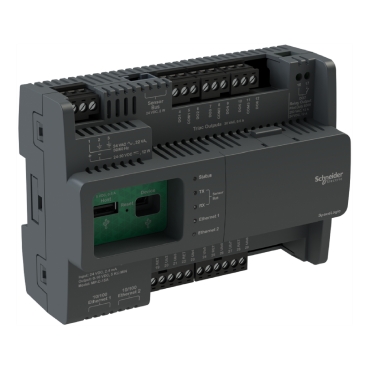
| SpaceLogic RP-C | Room-level control (VAV, FCU, chilled beams, lighting/blinds) | BACnet IP (B-BC), Zigbee, Bluetooth, Modbus RTU | Ceiling plenums, room enclosures |
Automation Servers like the AS-P host enterprise logic, coordinate multi-controller schedules, and aggregate global alarm databases. Dedicated field controllers like the MP-C execute standalone sequence loops independently of the server. If network connectivity to the central server is interrupted, field-level controllers continue running local PID control loops for critical pumps, fans, and valves without interruption.
I/O Capacity, Expansion Modules, and Power Budget
Selecting the correct model requires auditing physical point schedules against controller terminal capacities. SpaceLogic devices feature versatile Universal Inputs/Outputs (UI/O), which can be configured via software as voltage, current, resistance, or digital inputs, as well as analog outputs.
When physical point counts exceed local controller terminals, local or remote I/O expansion modules must be added. For instance, the AS-P Automation Server supports direct connection of central I/O expansion modules. However, maximum physical I/O expansion module limits (e.g., up to 32 modules per AS-P server) must be verified against power budget calculations, power supply output limits, and bus length specifications for the specific hardware revision. Oversized panels or long bus extensions may require secondary power supply modules (PS-24V) to offset voltage drop along the I/O bus.
Application-Specific Selection: Plant Control vs. Room Automation
Hardware selection should directly match the physical equipment and space type being controlled:
Central Plant & Complex Air Handlers (MP-C Series)
For complex mechanical systems requiring high physical I/O density and heavy PID loop processing, the SpaceLogic MP Controller Range documentation outlines dedicated models (such as MP-C-15A, MP-C-18A, and MP-C-36A). These devices offer generous onboard I/O configurations, high-voltage relay outputs for direct starter control, and high-speed IP connectivity suitable for mechanical rooms.
Connected Room Automation (RP-C Series)
For office spaces, guest rooms, and modular tenant areas, the SpaceLogic RP Controller Range documentation highlights flexible solutions for localized environmental control. RP-C controllers integrate HVAC control (VAV boxes, fan coil units) with expansion capabilities for lighting (DALI) and motorized blind control. Their modular nature allows ceiling plenum installations to scale easily as floor layouts change.
Wireless Sensor Integration and Mobile Commissioning Workflows
Modern commercial buildings demand flexible sensor placement and rapid engineering workflows. SpaceLogic field devices address these requirements with built-in wireless options and digital commissioning utilities.
- Zigbee Wireless Extension: By attaching a Zigbee adapter to an RP-C or MP-C controller, designers can integrate wireless temperature, humidity, CO2, and door/window contact sensors. This reduces conduit and cabling costs in glass-partitioned offices and historical retrofits.
- Bluetooth Connectivity: Field technicians can connect directly to controllers using smart devices, enabling quick diagnostic checks and manual overrides during site visits.
- SpaceLogic Commissioning Mobile App: Systems integrators can perform I/O checkout, load application logic, calibrate actuators, and generate compliance reports before the central EcoStruxure server network is brought online. This offline commissioning capability significantly shortens project hand-over schedules.
SpaceLogic Controller Selection Decision Framework
To finalize hardware selection, engineers can follow a structured review process across every control panel and zone equipment list:
- Identify the Control Scope: Determine whether the equipment is central plant management (AS-P), large mechanical equipment (MP-C), or room-level HVAC/lighting (RP-C).
- Verify Communication Medium: Choose between BACnet IP (preferred for high-speed, resilient RSTP rings) and BACnet MS/TP or Modbus RTU (for simple legacy drop lines).
- Tabulate I/O Points: Calculate required Universal Inputs (UI), Universal Outputs (UO), Digital Inputs (DI), and Relay Outputs (RO). Select a base unit and check if expansion modules are necessary.
- Audit Power and Enclosure Footprint: Verify power supply consumption across the controller and attached expansion units. Ensure panel dimensions accommodate DIN-rail configurations and thermal dissipation requirements.
- Plan Wireless and Mobile Access: Include Zigbee adapters where wire runs are cost-prohibitive, and configure Bluetooth access for streamlined field servicing.
By systematically addressing these criteria, BMS designers ensure robust data throughput, simplify future expansion, and reduce total cost of ownership across the building lifecycle. To request specialized technical assistance or request a technical quotation for project hardware engineering, consult with certified EcoStruxure specialists.